
Hamilton County Projected Versus Actual Release
KDOC calls its calculated field the “Anticipated release date.” It reflects the sentence and credits known when the record is viewed. It is not a promise of physical release. The actual date comes later, after staff account for new credits, forfeitures, court orders, holds, and transfers. Preserve the field label and retrieval date because the calculation can move.
A Hamilton County pretrial detainee has no sentence-based projected date. Bond, dismissal, a court release order, another agency’s hold, or later sentencing can determine the next event. A person serving a county-jail sentence may have an expected end based on the journal entry and jail credit, but Hamilton publishes no local formula. A state prisoner’s calculation belongs to KDOC.
Find a Hamilton County Projected Date
Choose the source by custodian. The KASPER search covers people sentenced to the Kansas Secretary of Corrections since 1980 who are incarcerated, supervised after prison, or discharged. It does not automatically include a person whose custody never went beyond Hamilton County Jail. For the local path, use the court’s sentencing record and the sheriff’s custody record together.
- Identify whether the person is pretrial, serving a Hamilton jail sentence, or serving a KDOC sentence.
- For KDOC, search by KDOC number. If unavailable, use name, birth date, and Hamilton as conviction county when applicable.
- Open the correct record and copy the anticipated-release label, status, case number, facility, and retrieval date.
- For county custody, obtain the journal entry and jail-credit calculation from the Kansas court portal or Hamilton clerk. Ask the sheriff for the release record.
- As the date nears, confirm with KDOC’s Sentence Computation Unit or the Hamilton sheriff. Never publish a hand calculation as official.
The Hamilton County release-record path explains how to obtain the later physical release time and destination.
The official KASPER entry page is shown below.
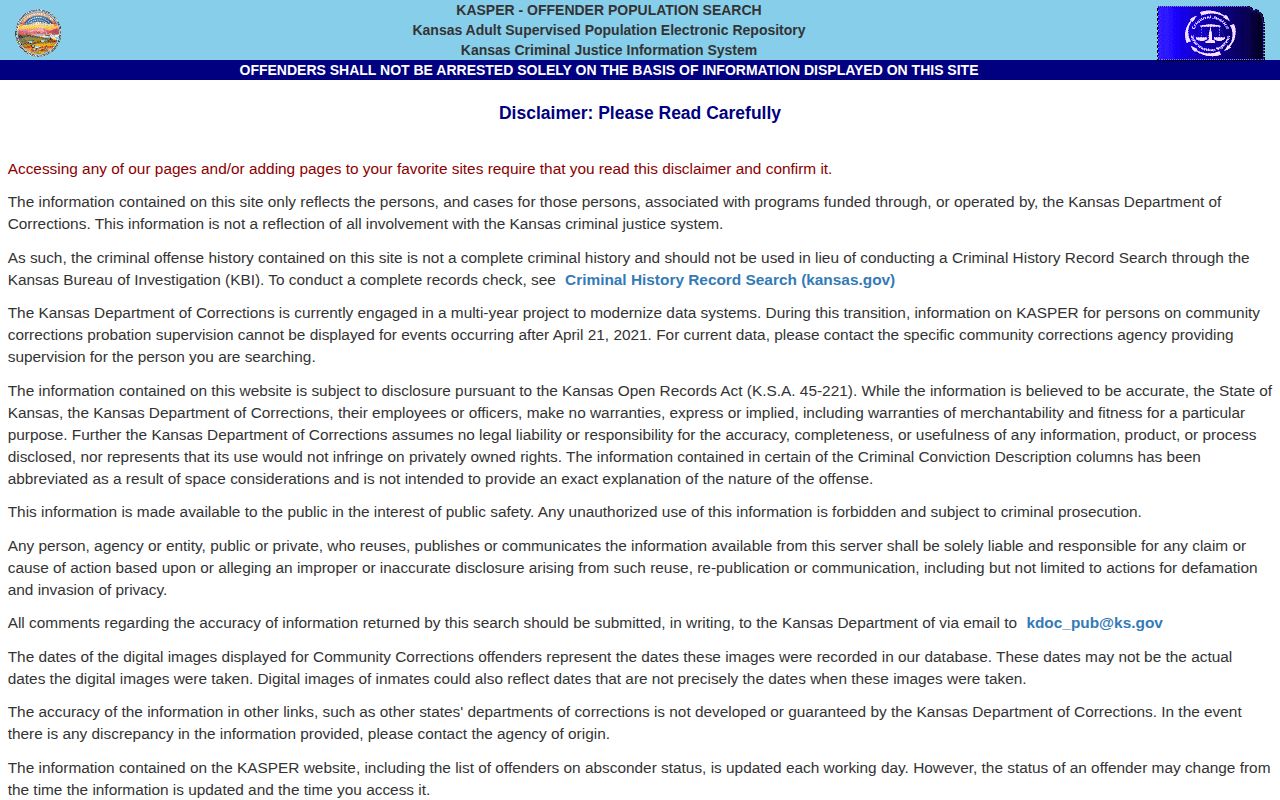
KASPER is the state-prison route. Its workday updates should not be mistaken for a live Hamilton County jail roster.
Hamilton County State Sentence Credits
For Kansas prison sentences, K.S.A. 21-6821 generally limits good time to 15 percent of the prison portion for crimes committed on or after July 1, 1993. This creates the familiar estimate that an eligible person serves about 85 percent. It is only shorthand. Eligible nondrug severity levels 7 through 10 committed on or after January 1, 2008 and specified drug-grid categories may reach 20 percent.
Some people serving only specified lower-severity crimes may earn up to 120 days of program credit. Qualifying work can include a GED, vocational training, substance-use treatment, or another approved risk-reduction program. Credits may be withheld or forfeited. Serious or off-grid mandatory terms may not permit the ordinary reduction. Offense date, severity, sentence structure, and mandatory terms control.
Never subtract 15 percent from the headline sentence and call it a release date. Concurrency, consecutiveness, sentence start, jail credit, mandatory terms, and later credit events all affect the result. Individual KDOC questions go to the Sentence Computation Unit at 785-296-3317.
Why Hamilton County Release Dates Move
A projected date is a live administrative calculation. It can move earlier when eligible credit is earned, or later when credit is lost. A court can amend the sentence. Another county or federal agency may place a hold. Parole eligibility can create a Board review date without creating a guaranteed release date.
| Factor | Possible effect | Where to verify |
|---|---|---|
| Good time earned or lost | Moves the date earlier or later | KASPER and Sentence Computation Unit |
| Program credit | May reduce an eligible term | KDOC sentence computation |
| Court correction | Changes the legal term or jail credit | Hamilton court journal entry |
| Detainer or hold | May prevent community release | Sending and receiving agencies |
| Parole outcome | Authorizes, denies, or delays an old-law path | Prisoner Review Board and KASPER |
Hamilton reports document transfers to Finney County and federal authorities. Those events show why the end of Hamilton custody is not always the end of all custody. A date must be paired with a destination check.
Confirm Hamilton County Actual Release
Recheck the owning agency when the expected date arrives. For a state prisoner, compare KASPER’s status and movement detail with KDOC confirmation. “Parole” can show departure from prison with supervision. “Discharged” means the KDOC sentence duty has ended. “Inmate” means the person should not yet be described as released, even if an anticipated date passed.
For Hamilton County Jail, call the Sheriff’s Office at 620-384-5616 and ask for release date, time, type, and destination. VINELink may provide an agency-fed alert, but Hamilton participation is unconfirmed. The VINELink inmate check explains how to test a named record and confirm an alert.
Note: Record the event name with its date, since a court order, jail exit, locator update, and publication date may all differ.
Hamilton County Jail Date Limits
Hamilton County publishes no local good-time policy, weekend-release rule, or jail computation formula. KDOC’s state-prison credit scheme cannot be copied onto a Hamilton County Jail sentence. The sentencing journal entry, stated jail credit, and sheriff’s actual release record govern the local path.
A weekly sheriff report may say “Time served,” “Out on Bond,” or “Time served probation granted.” Time served concerns a custodial part. Bond leaves the case pending unless a later order resolves it. Probation granted begins or continues court supervision. None supplies a reusable county formula for another person.
Ask the Hamilton County District Court clerk for the public sentencing or bond order and the sheriff for custody timing. Sheriff records hours are unpublished, so call first. If the person was transferred, obtain the receiver and keep both dates: the end of Hamilton custody and the later end of all physical custody.
The court record and custody record also serve different roles. A journal entry states the legal sentence, jail credit, and terms imposed by the judge. The sheriff documents the physical exit from local custody. One event may precede the other. Label each date instead of compressing them into a single answer.
Hamilton County Parole Eligibility Dates
Old-law indeterminate sentences use a different timeline. A parole eligibility date marks when the Prisoner Review Board may consider release, not a day when release must occur. The Board can grant parole, pass the case for a set period, or continue it for more information or deliberation. Even a grant requires later confirmation that the person left the institution.
Conditional release is another old-law calculation before the maximum date. Maximum release or sentence discharge means the sentence has been fully satisfied. Modern determinate sentences more often lead to mandatory postrelease supervision after the prison portion. These terms should be copied from the KDOC record or Board document, since substituting “projected release date” for each one hides a major legal difference.
K.S.A. 22-3717 contains offense-date and sentence-specific parole minimums and postrelease rules. It does not support a universal first-eligibility formula. For a Hamilton conviction, compare the KDOC case number with the Hamilton court file before relying on an eligibility date.
Read Hamilton County Release Status
KASPER status terms help prevent premature conclusions. “Inmate” identifies current KDOC incarceration. “Parole” indicates a person has left prison while state supervision continues. Conditional release or postrelease may appear in the detail. “Discharged” is the stronger indication that the state sentence duty has ended. “Absconder” describes supervision noncompliance and does not itself prove a new arrest warrant.
The official locator is updated each working day, not continuously. A weekend event or same-day change may appear later. Corrections can also be requested in writing through KDOC when the public record is wrong. For urgent timing, call the institution, Sentence Computation Unit, or listed parole office and retain the name of the office that confirmed the event.
KDOC records may contain movements with dates, an anticipated release field, supervision office, conviction county, and case number. Use those fields together. Hamilton as conviction county does not establish the current facility, home county, or supervising office, and a movement date is not always a community-release date.
When records conflict, prioritize the custodian for the event. Hamilton controls the jail release or transfer log. The district court controls its sentencing and bond orders. KDOC controls state sentence computation and prison movements. A weekly report is useful local evidence, but its publication date and short label may not reflect later changes.
Date differences can be legitimate. A judge may sign an order before jail staff complete release processing. KASPER may update on the next workday. A newspaper can publish days later. Keep each date with its event name and source instead of choosing one unlabeled date.
Document Hamilton County Release Dates
A search screen works for an informal check, but formal proof may require the underlying document. For a local term, ask the sheriff for the release date and time, release type, authority, and destination. Request the court’s sentencing journal entry and jail-credit terms separately. If another agency received the person, request the transfer record and receiving agency.
For KDOC, a movement or release record, parole certificate, or discharge certificate is stronger than a screen label. KASPER may preserve a discharged record, while the state retention schedule treats full inmate files and selected long-term documents differently. Those state periods must not be presented as Hamilton sheriff retention rules.
A precise request should name the person, KDOC or booking number when known, case number, and relevant date range. Ask for an electronic copy and a fee estimate. If no online result appears, test aliases, birth date, jurisdiction, custody type, and receiving agency before concluding that no record exists.
KORA requires a response as soon as possible and by the end of the third business day, but that deadline does not guarantee document production. A delayed response should explain the delay. Reasonable actual costs can apply. If part of a Hamilton record is closed, ask for the releasable remainder and the statutory basis for each withheld portion.
For a transfer, the sending record and receiving record should be kept together. The first proves when Hamilton or KDOC responsibility ended. The second may show when the next custodian released the person. Calling both dates “the release date” would conceal a continued period of confinement.
Hamilton’s weekly sheriff reports can supply an initial label and sometimes a date, but they are not a rolling booking ledger. They may describe bond, time served, probation, another-county transport, or federal handoff. Follow the label to the proper official source. A newspaper entry that says “Released to Federal Authorities” establishes a Hamilton exit, not a community release or a federal prison date.