
Hamilton County Parole Versus Probation
Hamilton County parole, postrelease supervision, and probation can all follow time in custody, but they arise from different legal paths. Parole generally applies to an eligible older, indeterminate Kansas prison sentence and depends on a Prisoner Review Board decision. Most guideline sentences for crimes committed on or after July 1, 1993 lead to mandatory postrelease supervision after the prison term. Probation is ordered by the district court, often instead of prison or after a county-jail term. A weekly Hamilton sheriff report may say “Time served probation granted,” which means confinement ended while court supervision began.
The agency and record source matter. KDOC and its field parole office handle parole and state postrelease supervision. The Hamilton County District Court and the responsible community-corrections or court-services office control probation records. KASPER is useful, but its disclaimer says current community-corrections events after April 21, 2021 cannot presently be displayed. That gap makes a blank or old probation result inconclusive.
| Supervision | How it begins | Best verification |
|---|---|---|
| Parole | Prisoner Review Board grants release on an eligible sentence | KASPER status, Board information, and listed parole office |
| Postrelease | Follows the prison part of many determinate sentences | KASPER detail and KDOC Parole Services |
| Probation | Hamilton County court orders supervision | Court docket, probation order, and responsible supervision office |
- Discharge
- The sentence or supervision obligation has ended.
- Absconder
- A person who has failed required supervision contact. The label alone does not prove a warrant.
- Revocation
- An official decision that supervision was violated and changed or withdrawn.
Verify Hamilton County Post-Release Supervision
Begin with the release phrase and sentence source. A Hamilton jail exit on bond is not parole. “Probation granted” points to a court file. A person leaving a KDOC institution may instead be on parole or mandatory postrelease. The KASPER offender search covers people incarcerated by KDOC, under post-incarceration supervision, and discharged. It does not cover every county-only booking.
- Match the person by KDOC number when possible. If searching by name, compare date of birth, conviction county, case number, and photograph.
- Read the current category. “Inmate” means the person is still in KDOC custody. “Parole” indicates release from prison with supervision. “Discharged” indicates no remaining KDOC sentence duty.
- Open the detail and note the listed parole office. Hamilton as the conviction county does not prove Hamilton is the current supervision county.
- For probation, search the Kansas court portal and obtain the probation order or later discharge or revocation entry from the Hamilton clerk.
- Confirm a current status directly with the office that owns the record, especially when KASPER and the court docket have different update dates.
The broader Hamilton County released-inmate search can help identify whether the original exit was bond, time served, transfer, or a state-prison transition before supervision is checked.
Hamilton County Parole Office Assignment
Hamilton County has no listed local KDOC parole office. KDOC assigns the county to the Garden City Parole Office in the South Region. That office serves a multi-county area, including Hamilton, Greeley, Finney, and Kearny Counties. Still, the office shown on the individual KASPER record should control. The county of conviction, present home, and supervision site can differ.
816 N. Campus Drive, Suite 500
Garden City, KS 67846
620-272-3879
Office hours are not published in the research; call first.
KDOC automated parole reporting: 866-570-7225
The official office list is also the best place to check whether assignments have changed. Do not route a probation question there merely because a person once served a state sentence. The court order identifies who supervises probation.
The manifest image below comes from the KDOC parole office contact list.
It provides the official regional contact route, while the person’s KASPER detail remains the better source for an individual assignment.
Hamilton County Absconder Record Checks
KASPER maintains separate parole absconder and community-corrections absconder searches. The parole tool can filter the supervision location before absconding, including Hamilton County, and may show a photograph. An absconder label means required contact was missed. Historic KDOC guidance cautions that an absconder may or may not also have a warrant or an NCIC entry.
Verify any warrant with KDOC, the assigned officer, the court, or law enforcement. Do not treat a locator label as an arrest command. Common supervision duties can include reporting, following travel or residence rules, completing programs, and obeying court or Board conditions, but the actual written order governs each person. A suspected violation can lead to investigation, a hearing, modified conditions, or revocation. Those steps are not interchangeable.
The official absconder search is shown in this source image.
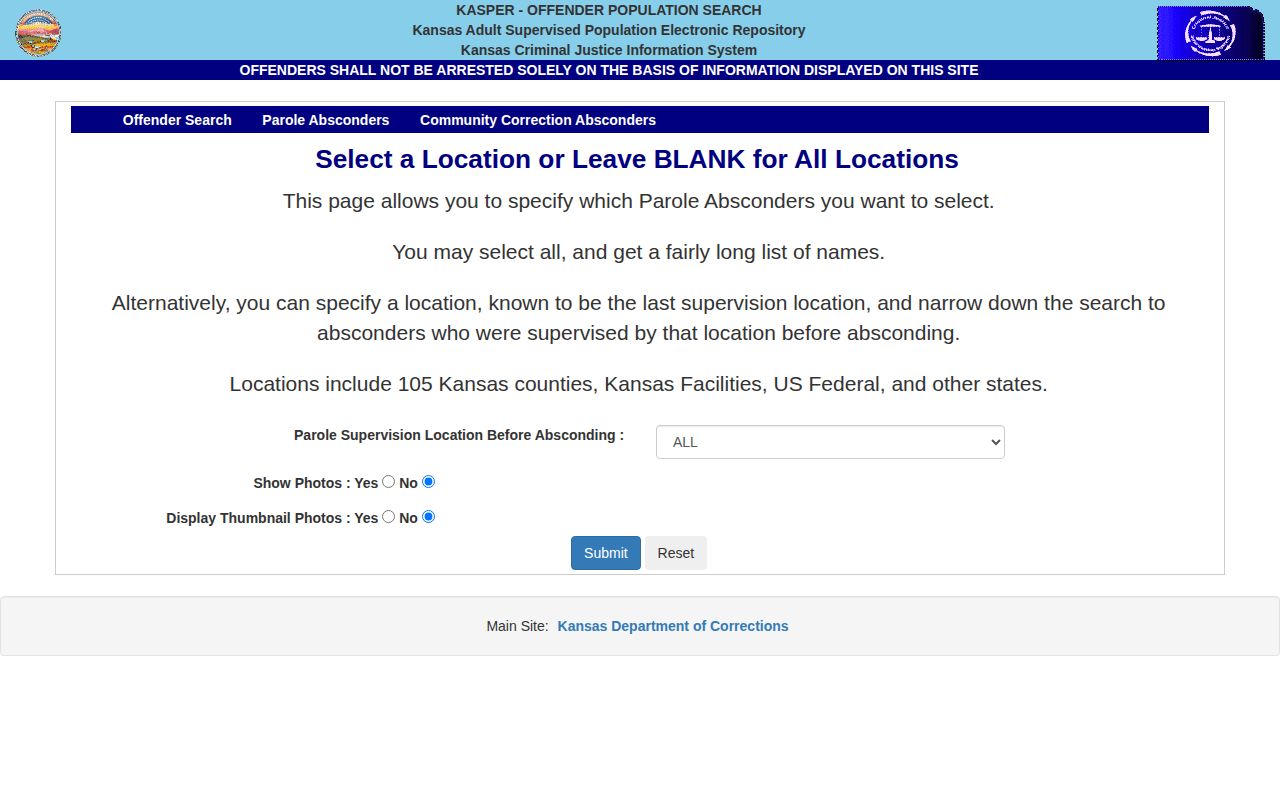
The filter is a lead for current verification, not proof that a warrant exists or that a person has returned to custody.
Hamilton County Supervision Discharge
Supervision ends through an official discharge, not merely because a public entry disappears. In KASPER, “Discharged” is the stronger sign that no KDOC sentence obligation remains. It differs from parole, conditional release, or postrelease, all of which describe release from incarceration with an ongoing duty. For probation, seek the court’s discharge order or other final docket entry.
Formal proof may require a parole certificate, maximum-sentence discharge certificate, probation discharge order, or KDOC record. KASPER keeps records for discharged state sentences, although reversal, expungement, or executive clemency can affect public visibility. A no-result can also reflect a name variation or the known community-corrections display gap. Preserve the exact label and retrieval date when status timing matters.
Note: A physical release date and a later supervision discharge date answer two different questions and should never be merged.
Hamilton County Parole Hearing Records
The Prisoner Review Board public-comment calendar posts rolling monthly lists. Public-comment sessions occur one month before the parole hearing. The example described in the research separates a comment month, the next month’s eligibility hearing, and a possible release month after that. None of those dates alone proves release.
Lists may show commitment name, KDOC number, offense county, case number, offense code, and housing-facility group. County of offense is not current residence. Under K.S.A. 22-3717, eligibility is the threshold for Board review. A grant authorizes parole subject to release processing, a pass denies it for a period, and a continue delays a final decision.
No official name-based individual decision database was verified. Request the decision from the Board and then check KASPER for the status change. If KASPER still says “Inmate,” do not describe the person as released. The Board process page explains those outcomes.
The captured monthly calendar page illustrates the official schedule channel.

Its timing should be paired with a later KASPER status or direct Board confirmation before reporting a Hamilton County release.
Hamilton County Probation Record Trail
The local court file is the durable source when a sheriff report says “Time served probation granted.” Search the Kansas Public Access Portal for Hamilton County and match the case number, parties, and dates. Look for the journal entry, sentencing order, probation order, later revocation, and discharge. Some older documents may require the courthouse terminal or a direct request.
The Hamilton County District Court clerk is at 219 N. Main Street, PO Box 745, Syracuse, KS 67878, and the listed phone is 620-384-5159. The court can provide its public orders, but it should not be asked to certify the physical jail-exit time. Pair the court order with the Hamilton sheriff release record for that event.
A missing online probation entry is not proof that supervision ended. KASPER’s post-2021 community-corrections limitation, older document access, sealing, expungement, and ordinary update lag can each affect what appears. State only what the responsible office or record confirms.
Expungement timing also depends on supervision. Under K.S.A. 21-6614, many waiting periods run from sentence satisfaction or discharge from probation, parole, postrelease, community corrections, conditional release, or a suspended sentence. The day of jail release may be much earlier. The specific offense, sentence, and discharge record control eligibility.
Hamilton County Supervision Notifications
VINELink is built for custody events, not a complete supervision history. Kansas is selectable, but Hamilton County Jail participation was not independently confirmed. A released or out-of-custody result is agency-fed information and should be checked with the listed supplier. It does not replace a probation order, parole record, or discharge certificate.
KDOC also offers a separate Victim Services notification form. That program is not the public KASPER locator and is not VINELink. Use the channel that fits the event, then keep the confirmation details. A notice of prison release does not, by itself, establish that postrelease supervision ended.
The KBI Registered Offender search is another distinct system. It covers only people with qualifying registration duties and is not a general parole or probation list. Presence there does not explain the full custody trail, and absence does not establish supervision discharge. Keep registry, custody, and supervision findings in their proper lanes.
Supervision records also change over time. A court can modify probation, revoke it, or later enter a discharge. The Board can set parole conditions, respond to violations, or record the maximum completion of an eligible sentence. Save the source date and exact wording. A screenshot without its retrieval date can make a past status look current.
If two sources disagree, ask which office controls the event. The Hamilton court controls its probation orders. KDOC controls parole and state postrelease records. The sheriff controls the local jail exit. VINELink reports what a supplying agency sends. This source-by-event method avoids turning a delayed alert or incomplete locator entry into a false statement about supervision.