
KDOC Hamilton Release Outcomes
Kansas Department of Corrections institutions hold people serving state sentences. KDOC can place a person convicted in Hamilton County at any institution it assigns. That makes a statewide lookup essential. A county sheriff report is appropriate for a local jail exit, while KASPER, the Kansas Adult Supervised Population Electronic Repository, is the official public route for state custody and supervision.
Release from a KDOC institution may begin parole, postrelease supervision, or conditional release. Parole is supervised release authorized under the applicable sentence framework. Postrelease is a required supervision term that follows the prison portion of many modern determinate sentences. Conditional release is an old-law sentence concept. Discharge is different: it means the KDOC sentence obligation has ended. A person can be out of prison yet not discharged.
| KASPER status or term | Safe reading |
|---|---|
| Inmate | Still in KDOC custody; an anticipated date is not an exit |
| Parole or postrelease | Out of prison but still under state supervision |
| Conditional release | Released under the applicable old-law calculation and conditions |
| Discharged | No remaining KDOC sentence obligation shown |
Search Hamilton KDOC Release Records
Open the official KASPER search and disclaimer. A KDOC number is the strongest search key. A name search can be narrowed by birth date, race, sex, and conviction county. Choose Hamilton as the conviction county when that fact is known, but do not assume a person now lives or reports there.
- Accept the official disclaimer and search by KDOC number when available.
- For a name search, add date of birth and Hamilton as conviction county to separate similar records.
- Open the detail record. Record the KDOC number, current status, case number, institution or movement information, and listed supervision office.
- Compare the case number with the Kansas court portal and label each date by what it represents.
- For formal proof, ask KDOC for the relevant movement, release, parole, or discharge document.
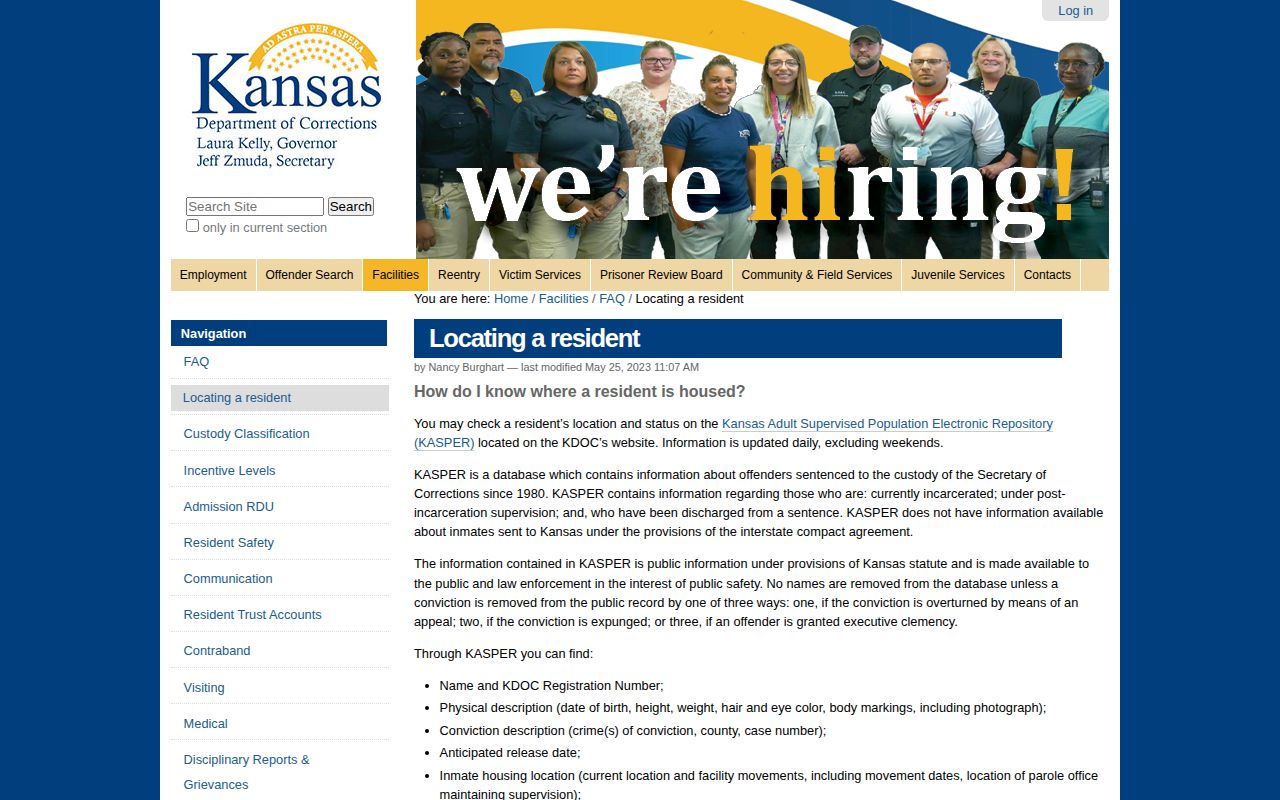
The KDOC locating FAQ explains the locator’s scope and anticipated-release terminology. The successful source image below shows that official KDOC context.
The locator can preserve records for people under supervision and people discharged from a sentence. Its displayed data must still be read in context. A release from county jail is not necessarily a KDOC event, and a KDOC discharge date may be later than the day the person left prison.
Hamilton KDOC Release Dates
KDOC uses the term “anticipated release date.” It is a current calculation, not a guarantee. Sentence start, jail credit, concurrent or consecutive terms, offense date, severity level, earned or forfeited good time, program credit, and mandatory terms can affect it. The record should be checked again as the date approaches.
Kansas law commonly limits good time to 15 percent of the prison portion for eligible crimes committed on or after July 1, 1993. Some lower-severity categories may reach 20 percent, and certain eligible people may receive program credit. Those rules have exceptions. Serious or off-grid mandatory terms may not receive the ordinary reduction. Never subtract a percentage from the headline sentence and publish that result as official.
For a discrepancy or sentence-specific calculation, contact the KDOC Sentence Computation Unit at 785-296-3317. The Projected Release Date page separates anticipated dates, parole eligibility, and confirmed release events in more detail.
Hamilton Supervision After KDOC Release
Hamilton County’s current regional assignment is the Garden City Parole Office, South Region. The office serves Hamilton and several neighboring western Kansas counties. Still, a person’s conviction county, current residence, and actual supervision office can differ. Read the individual KASPER record before calling.
KDOC Garden City Parole Office816 N. Campus Drive, Suite 500
Garden City, KS 67846
620-272-3879
Automated parole reporting: 866-570-7225
The KDOC parole office directory is the current source for the assignment. The Prisoner Review Board handles parole decisions, revocations, and related conditions, while Parole Services carries out field supervision. A Board grant authorizes a release process. A “pass” is a denial for a period, and a “continue” postpones a final decision. Monitor KASPER for the later status change rather than treating the hearing result as the physical exit record.
Probation is usually imposed by a court instead of following a prison release. KASPER warns that community-corrections probation events after April 21, 2021 cannot presently be displayed. For a Hamilton report saying “time served probation granted,” use the Hamilton District Court order and responsible community-corrections source, not KASPER alone.
Request Hamilton KDOC Release Proof
KASPER can support an informal status check. Stronger documentation may include a KDOC movement record, parole certificate, release record, or discharge certificate. Ask for the specific existing record that answers the question. A discharge certificate can prove sentence completion, while a movement record may better establish the day the person left an institution.
For a displayed KASPER accuracy problem, use kdoc_pub@ks.gov. Describe the record and the field at issue without sending needless sensitive details. Kansas corrections retention schedules govern state series, but public locator visibility is not the same as archival retention. A record missing from the public interface does not prove that KDOC never held it.
- Anticipated date
- A changing sentence calculation, not confirmed release.
- Parole
- Release from prison under state supervision.
- Postrelease
- A supervision term that follows the prison portion of a determinate sentence.
- Discharge
- End of the KDOC sentence obligation.
Hamilton Jail Versus KDOC Release
A Hamilton County Jail exit and a KDOC institution release belong to different custodians. Use the sheriff for a local booking, bond, time-served exit, or transfer from Hamilton. Use KDOC for a Kansas prison placement, state sentence movement, parole, postrelease, and discharge. If Hamilton transferred the person into KDOC custody, the local exit date marks only the start of the state route.
Court records provide the legal bridge. Search the statewide court portal with Hamilton County selected and compare the case number with KASPER. The judgment can establish the sentence. KDOC then controls institution placement and sentence status. The Hamilton County Jail / Hamilton County Sheriff’s Office page covers the local record, while the Hamilton County released inmate search combines the available routes.
No KDOC prison was found physically inside Hamilton County. Do not present Garden City’s parole office as a prison or imply that every Hamilton conviction leads to the same institution. KASPER’s individual facility and movement information controls.
A no-result also needs a narrow reading. Check name variants, date of birth, the KDOC number, and the Hamilton court case number. A county-only detention may never create a KDOC entry. Public visibility can also change after reversal, expungement, or executive clemency, while older source records may follow a separate retention schedule. If the identifiers and jurisdiction are sound but the result remains absent, ask the sheriff whether a state transfer occurred, check the court judgment, and contact KDOC about the specific record. “No public KASPER result found” is more accurate than claiming no Kansas custody ever existed.
Source dates can differ without being wrong. A court signs a sentencing or release order, an institution records physical movement, a locator posts an update, and a parole office begins supervision. Label each date by event. For a Hamilton County state sentence, that practice preserves the key distinction between legal authority, prison departure, supervision start, and final discharge.
Notification is another separate channel. KDOC Victim Services offers its own registration process and contact line, 1-866-404-6732, for qualifying registrants. It is not a public locator and should not be described as KASPER or VINELink. A notification may help track a future corrections event, while KASPER remains the public status check and the underlying KDOC record remains the stronger proof.
Absconder searches also have a limited purpose. KDOC publishes separate parole and community-corrections absconder tools. An absconder is a person who failed required supervision contact. The label does not, by itself, prove a current arrest warrant or new custody. Confirm the supervision office and any warrant with the responsible agency. This matters after a Hamilton release because a past prison exit, current supervision status, and later enforcement action are three distinct events.
A parole hearing calendar is also not a release list. The Prisoner Review Board posts monthly public-comment and hearing material, but the listed month can differ from the hearing month and any possible release month. After a hearing, contact the Board for the decision and monitor KASPER. Even an approval remains subject to the release process, conditions, and physical movement. If the public status still reads “Inmate,” describe the person as in KDOC custody.
For court reconciliation, use the Kansas District Court Public Access Portal with Hamilton County selected. A judgment or journal entry establishes the legal sentence and may show jail credit. KDOC controls the later computation and movements. When the sources display different dates, preserve each label and retrieval date. That avoids turning a sentence date, anticipated date, prison departure, supervision start, and final discharge into one inaccurate event.
Public Record Search
Sponsored Results